You’d be surprised at the amount of single-use plastic waste travellers contribute. Think about it. If you use a new plastic toothbrush for every trip, or worse — one toothbrush a day, since hotels replenish your amenities daily, that’s a lot of plastic being thrown out. Likewise with plastic bags, single-use plastic cutlery, ziplock bags, plastic water bottles…and the list goes on. It’s tempting to use disposable consumables because of their convenience, and the idea of use-and-throw makes us think we can lighten our bags as the days go by on the trip. But the growing weight of plastic waste on earth — 8 million tonnes of plastic end up in the oceans every year (!) — is not to be taken lightly. As you have probably heard, plastic can take up to a thousand years to break down.
It may require a bit more effort, but travellers who want to do their part for the planet can choose eco-friendly products over single-use plastic. Here are some frequently used travel essentials that can easily replace plastic products. These hurt less for both our beloved earth and your wallet in the long run. Now, who doesn’t love a win-win scenario?
1. Bamboo Toothbrush
Eco-friendly toothbrushes are one of the easiest ways to reduce your ecological footprint. Bamboo is biodegradable, and there are plenty of options for bamboo toothbrushes these days when it comes to grip styles and bristles’ softness.
Here are some tips to make the most of your shift to bamboo toothbrushes:
- After you finish brushing your teeth, rinse the bristles thoroughly for around 30 seconds to minimize leftover toothpaste or food particles.
- Avoid leaving your toothbrush in a case or holder as that would encourage the growth of unwanted microorganisms.
- Change your bamboo toothbrush just as you would a regular one — every three to four months or when the bristles start to look frayed.
- Before composting the bamboo toothbrush, remove the nylon bristles first, as nylon is not biodegradable.
- Don’t expect bamboo toothbrushes to come in fancy packaging, as most companies use recycled materials instead such as simple paper wrapping.
Read More: How you can do your part for sustainable tourism
2. Foldable tote bag
View this post on InstagramA post shared by Matador (@matador.up) on
Although Singapore’s grocery stores such as NTUC FairPrice and Cold Storage are still giving out free plastic bags, there is a growing number of residents bringing foldable tote bags for their shopping to reduce plastic bag use. As we continue making progress there, we can be extending that practice to our travel shopping. Whenever you buy things while travelling, carry your tote bag with you and turn down the plastic bags that retail merchants may offer. The Matador Transit Tote is a good choice for travellers as it’s one of the few foldable tote bags that have a zip to ensure items inside the bag stay in, as we are likely to store this in the overhead compartment on the plane. When not in use, it folds up to palm-size, making it convenient to stuff in a handbag or backpack. To top it off, it’s completely waterproof! You can find the Matador Transit Tote at stores like Outdoor Life, Tangs, and Lazada.
On top of that, there are cheaper options without the zip that are just as useful as an alternative to plastic bags. Just remember to always bring it out with you.
3. Packing cubes
Are you still packing your clothes in plastic bags or plastic ziplock bags? You are most probably trapping a lot of air in them, which makes it less efficient when it comes to luggage space. And the Earth suffers if you throw out these plastic bags with every trip you make. Also, have you ever had to sit through a hostel roommate digging through endless plastic bags to find what they need in the middle of the night? The awkwardness is real.
Packing cubes help to organise your clothes just like you would pack papers in files. They enable you to fit clothes in your luggage more efficiently, so you can easily (and quietly) find what you need. There are many stores you can find packing cubes. Travel brands like Eagle Creek and Osprey are available in stores like The Planet Traveller, Boarding Gate, Outdoor Life as well as some department stores. The ones made of paraglider cloth at Muji are very lightweight and folds into a pouch smaller than your fist. Daiso carries different sizes of packing cubes as well.
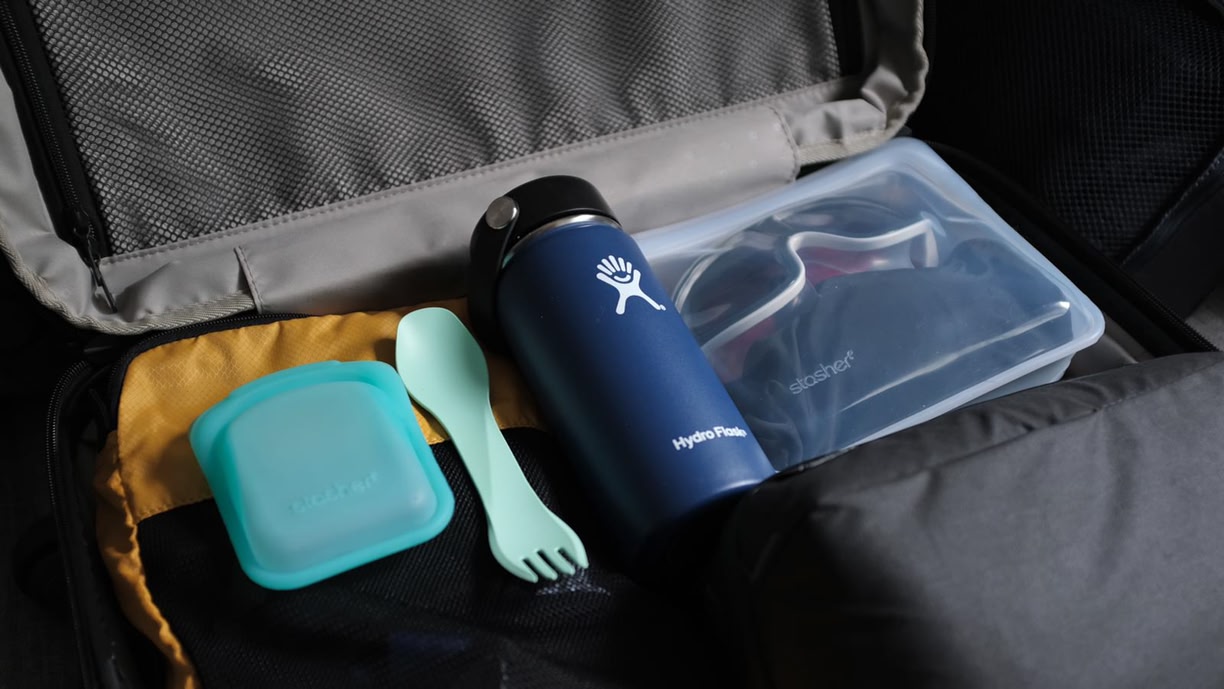
4. Reusable water bottle
View this post on InstagramA post shared by Hydro Flask Singapore (@hydroflask.sg) on
According to National Geographic, more than a million plastic water bottles are sold every single minute globally. Each bottle then takes more than 450 years to completely degrade. Now, you can do your part in reducing plastic bottle waste by carrying your own water bottle. You can usually fill up your bottle with water at the airport, restaurants you dine at, your hotel breakfast station, and also by boiling water in your hotel room (in countries where drinking from the tap is safe, of course).
Smart tip: Get an insulated water bottle so that you can store warm water. You will be most thankful for that when you travel during the winter months.
5. Reusable utensils
View this post on InstagramA post shared by humangear (@humangear) on
There will be instances during your travels when you order takeaways or even order in. To play your part as a responsible traveller, opt out of plastic cutlery by bringing your own reusable utensils.
A popular sustainable travel product is a spork — a hybrid utensil that has a shallow scoop with two to four tines. It’s a great invention, but if you’ve ever tried eating with a spork, you may find it a little challenging. Some people find it too small and shallow for drinking soup, and the tines are also too short to grip something thick and heavy such as a slice of apple. Nevertheless, if you can only bring one utensil instead of two, a spork will serve you well enough, especially for cup noodles. You will be able to feed yourself both noodles and soup at one go. Yum.
A good alternative would be to have a fork and spoon at each end, so that you can still save luggage space by packing just one utensil. Humangear created just that with their GoBites Uno. This is also available at travel stores like Boarding Gate and Outdoor Life.
6. Reusable silicone ziplock bags
View this post on InstagramA post shared by Stasher (@stasherbag) on
Singaporeans love ziplock bags. They help keep things dry, allow us to carry food and snacks around, and the transparency allows us to easily identify what’s in them. But, alas, they don’t last long and contribute to the Earth’s mountain of plastic waste.
Enter silicone ziplock bags. They work exactly the same as our regular ziplock bags, just that they are eco-friendly, environmentally safe, and long-lasting.
Some tips for using these silicone ziplock bags:
- Use soap and water to wash them right after use, and air dry them before reusing.
- Don’t turn the bag inside out as that may compromise the sealed edges.
- Don’t put sharp objects in them as that may puncture the bags, which renders them useless for its original intent to keep items dry.
- You can label your bags using whiteboard markers, or use trusty old Sharpies and 3M magic tape.
Smart tip: Use one of these silicone bags to store your toiletries too. It’ll make customs clearance a breeze in countries that require you to store your liquids in a transparent bag.
7. Solid toiletries
View this post on InstagramA post shared by Lush Cosmetics North America (@lushcosmetics) on
Another way to help save our planet is to replace liquid toiletries with solid ones, because they last so much longer and don’t involve plastic packaging. Also, since they are not liquids, these will always fit in your carry-on bag without you needing to worry about the travel limits on liquids. No more extra weight from carrying toiletry bottles too. These days, there are solid toiletries to replace any of your regular liquid toiletries: solid shampoo, solid conditioner, solid cleansing bar (facial wash), a bar of soap for your body, solid lotion bar, solid perfume and even solid toothpaste. They’ve got all the essentials covered.
Curious to check them out? You can find many of these options at Lush stores, with a variety of scents to choose from. Alternatively, you can check out The Social Space for other organic solid toiletries options as well.
After use, leave these solid toiletries to dry as much as possible. Then, store them in one of the reusable ziplock bags mentioned in the previous section and you’re good to go.
8. Silicone travel bottles
View this post on InstagramA post shared by humangear (@humangear) on
For some toiletries that you either can’t find a solid version of, or if you simply aren’t sold on the idea of solid toiletries, the next best thing you can do is to use reusable silicone travel bottles. Fill them up with your favourite shampoo, conditioner, shower gel, facial wash and so on instead of using the hotel’s travel-sized toiletries. After all, it’s also better for your hair and skin to use the same shampoo and shower gel during your trip instead of applying different formulas with each night at a different hotel.
Why silicone? Well, silicone is more flexible, allowing you to squeeze the container easily, so you can use your toiletries to the last drop. The extra wide mouth compared to plastic containers also makes filling the bottles much easier and quicker.
9. Organic sunscreen
View this post on InstagramA post shared by Natural Zinc Sun Protection (@solzinc) on
Sunscreen — never leave home without it. Your skin needs protection from the sun’s harmful ultraviolet rays, and your older self will thank you for better skin if you religiously slather it on now. But did you know that swimming in the sea with a regular sunscreen is harming marine life? The active ingredients in regular sunscreen formula are contributing to rapid bleaching of our coral reefs, which in turn harms the aquatic ecosystem. To minimise your damage to the environment, reach out for eco-friendly sunscreen that don’t contain the following ingredients:
- Petroleum (commonly known as “mineral oil”)
- Titanium dioxide
- Oxybenzone
- Octinoxate
These ingredients take a long time to biodegrade, if even biodegradable, and are known to harm marine life. Instead, opt for a mineral sunscreen that is reef safe, ocean safe, plastic-free, and chemical-free.
10. Reusable cotton pads
Skincare and cotton pads go hand in hand, and chances are you use about two to three cotton pads for your beauty routine every day. That may not sound like much, until you do the math. Over a year, you would be throwing out more than 1,000 cotton pads. Thankfully, there’s a sustainable alternative to using cotton pads that won’t compromise your skincare — reusable cotton pads.
There are several types of reusable cotton pads, such as cotton flannel or crochet rounds. Either choice works for both makeup removal and toner application, with the cotton flannel ones being gentler on the skin. Both types are sold online or at pop-up handicraft stores. You can take a look on Carousell for handmade ones, or even sew some yourself. They are just as effective as single-use cotton pads, but be sure to keep them clean by either hand washing them with soap and water, or add them to your regular washing machine load (but place the cotton pads in a wash bag first). Some people are paranoid about the bacteria and use boiling water to rinse them, but that is unnecessary. If you’re diligent about washing them, each of these cotton pads can be reused 1,000 times!
These 10 earth-friendly products listed above are all effective, require little to no effort to reuse, and are a step towards a sustainable travel lifestyle you can feel good about. You can find them easily at travel stores in Singapore, or online. Pack these on your next trip onwards and they will last you for many trips to come. Most importantly, the Earth will thank you for making these choices.


